3D Printing
Metal 3D Printing Services — SLM Titanium, Aluminum & Stainless
Fully dense metal hardware with lattices and organic geometry no cutter can reach — then CNC-finished datums on the machining floor next door. Density reports on every build.
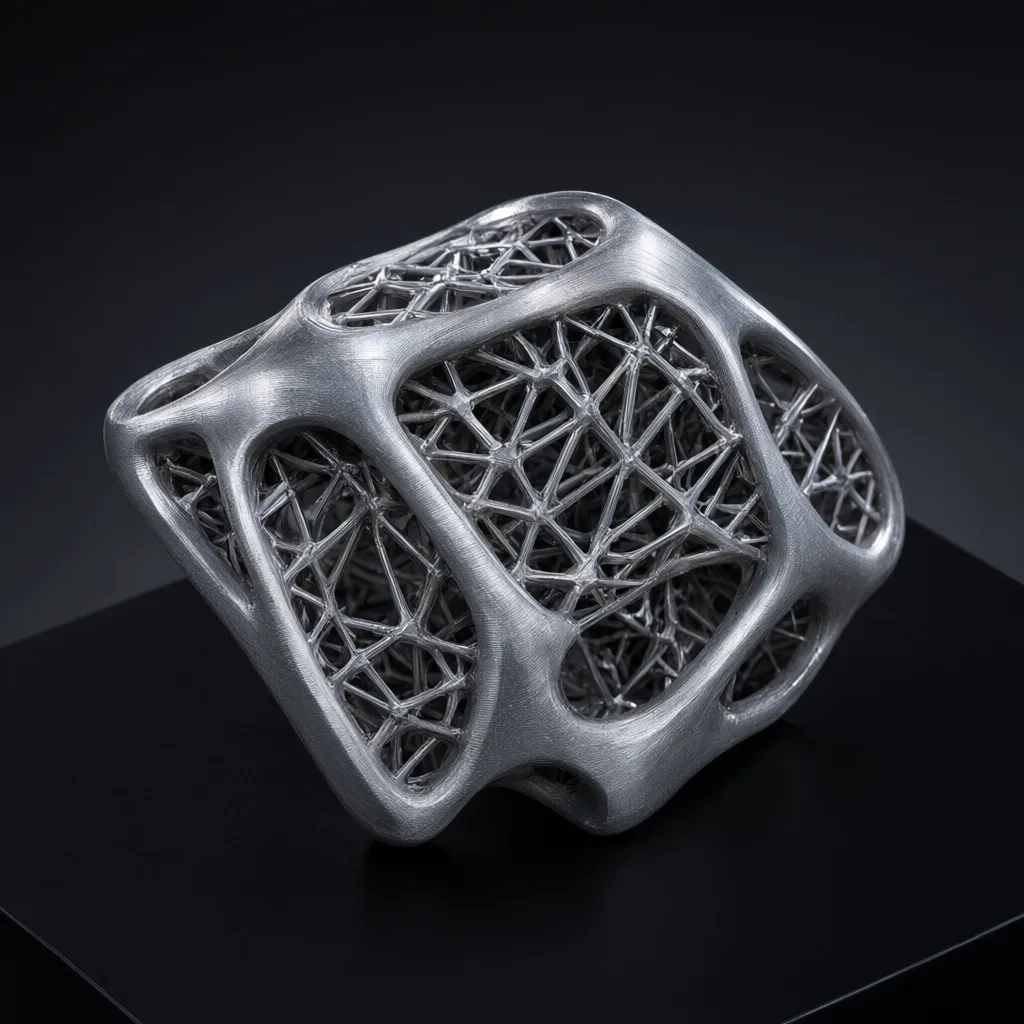
Metal 3D printing (SLM/DMLS) fuses metal powder into fully dense parts, layer by laser. Aluminum AlSi10Mg, stainless 316L, tool steel and titanium Ti-6Al-4V build into near-net-shape hardware with lattices, conformal cooling channels and organic topologies no cutting tool can reach. On MOMAKING's platform, printed metal arrives with CNC-finished datums, media-blasted surfaces and density reports — hardware you install, not samples you photograph.
When Printed Metal Beats Machined Metal
- Geometry machines cannot cut: closed internal lattices, conformal cooling inside a mold insert, scrolled internal volumes, part consolidations that merge twelve machined pieces into one.
- Weight-critical structures: topologically-optimized brackets in Ti-6Al-4V shed 30–60% mass while holding load paths — the drone, robotics and medical-frame work that fills this queue.
- Low-volume hard parts: 10–500 units of a $2,000 five-axis part often print for a fraction of machined cost because the laser does not care how complex the surface is.
- Tooling inserts: conformal-cooled mold and die inserts cool faster and warp less; our own mold shop uses this route for difficult tools.
Materials on This Line
AlSi10Mg: the workhorse — light, strong, thermally conductive; heat sinks, drone booms, motor housings. T4/T6 heat treat available. 316L stainless: corrosion-tough hardware, filters, marine fittings. Ti-6Al-4V: maximum strength-to-weight for frames, implants-route hardware and high-load brackets. Tool steels: insert work and repair overlays. Each build carries powder lot traceability and witness coupons; density typically exceeds 99.5% with HIP available on request for fatigue-critical parts.
Accuracy and the CNC Handoff
As-built accuracy is ±0.05–0.1 mm plus 0.5% of length; surfaces run layered and matte. Here is the factory advantage most print shops lack: the machining floor sits in the same building. Bearing seats, seal bores and mounting faces print oversized, then get milled to ±0.02 mm on our VMCs in the same order — printed complexity where it pays, machined precision where it must, one shipment, one report.
Lead Time, Post-Processing, Cost Logic
Typical flow: 3–5 working days — print (machine hours by height), depowder, stress relief, plate separation, media blast, any CNC datums, inspection. Larger builds and HIP cycles extend the schedule; the quote states it honestly. Cost follows packed build volume, support area and post-op count more than part size — self-orienting to minimize supports is the biggest lever, and that engineering happens free at prep. At production volumes we price the print-vs-machine crossover explicitly so nobody overpays either way.
Files and Verification
Send STEP for design freedom and STL for validated meshes; wall minimums start at 0.8 mm, lattice struts from 0.3 mm, and overhangs steeper than 45° self-support. Fatigue-critical parts should flag service loads — witness coupons from your build report tensile results, HIP closes porosity risk. Reports ship with every order; global express from Shenzhen. Engineering chat: [email protected] / WhatsApp +1 315-623-3808.
Frequently Asked Questions
Is printed metal as strong as machined?
What surface finish do printed metal parts have?
Why is metal printing cheaper for some parts?
Can you print and machine in one order?
Reading a Metal-Print Quote: What Each Line Item Actually Buys
Printed-metal invoices look mysterious until each line is translated. Build volume: the machine-hours of laser sweeping your height in the chamber — tall parts pay it even when thin, because the laser re-coats and re-scans per layer regardless of how little you occupy. Supports: tree structures anchoring overhangs and conducting heat to the plate; cut and filed by hand, priced by the area they cover, minimized by orientation we choose. Plate separation & base removal: bandsaw plus machining the bottom witness flat — the reason a 0.5 mm-thin base is a flag. Stress relief: a furnace soak before separation that stops residual build stress curling your part off the plate mid-saw — skip it only when nobody needs the part straight. HIP: hot-isostatic pressing that closes internal porosity and lifts fatigue life; a fatigue-critical bracket's most important dollar. CNC datums: the seats, faces and bores milled here after print — the line that makes the part install instead of aspire to install. A quote that bundles these into one number is either lazy or guessing; ours itemizes so you can see, for instance, that skipping color anodize on a Ti frame saves the support-removal afternoon that outnumbers the laser time.
Which Metal, Which Machine: AlSi10Mg, 316L, Ti-6Al-4V in One Paragraph Each
AlSi10Mg is the default structural print: light, thermally conductive, T6-heat-treatable to a respectable ~230 MPa yield class, and the only one of the three that anodizes (earthly greys to golds). Heat sinks with printed internal fins, drone booms and motor mounts are its daily output. 316L stainless is the corrosion and temperature workhorse — filters, manifolds, marine hardware — machinable after print with the same tooling discipline as wrought 316, polishable to sanitary finishes. Ti-6Al-4V is the strength-to-weight answer: printed lattice frames and surgical guides and brackets that must carry a person or a rotor; it machines painfully (that is why printing it often wins — the laser does not care about complexity) and biocompatible-grade routes come with powder lot certification on the documented lane.
The fatigue question deserves the honest version: as-built SLM samples scatter below wrought properties, HIP plus appropriate design recovers most of the gap, and we design-to-coupon from your witness bars rather than brochure numbers — the coupon tensiles arrive with your parts. When the load case is truly wrought-class-critical, the right answer is sometimes “print the near-net shape, machine the critical section,” and sometimes “this is a five-axis part, print nothing” — the crossover quote shows both, and the machine shop next door executes either.
Lattice Design: Printed Structures You Cannot Buy Any Other Way
Printed lattices turn metal into engineered compliance: a Gyroid or diamond lattice at 30% relative density carries load like foam, springs like a mattress, and cools like a sieve — and none of it is a casting or a machining dream. Real uses we print weekly: lattice-backed footbeds and orthotic interfaces where the spring rate is tuned per zone (strut diameter and cell size mapped to pressure maps from a scan), lightweight brackets where the lattice fills the stress-field envelope a topology solver drew, thermal pins with lattice fins tripling surface area inside a volume a fin-stock could never reach, and acoustic damping panels where the lattice's internal friction eats vibration a solid wall would ring. Design rules: struts from 0.3-0.4 mm (process floor), cell sizes 1-4 mm for prints in the AlSi10/Ti band, support-eliminating orientations (Gyroid is famously self-supporting), and a solid skin 0.8-1.2 mm over any lattice face that must gas-seal or wear. Per-zone density grading (soft heel, firm arch, rigid edge) arrives from your pressure data or our scan service, exported straight to build files with the grading baked into the mesh.
Lattice and topology jobs quote by packed build volume and post-processing plan, not part count; send the load case or the scan and the first lattice study returns with the quote.
Get this part priced
Upload your STEP file - AI quote in seconds, engineer-verified quote within 24 hours.