Custom Mold Making
P20 / 718H / NAK80 / S136, single & multi-cavity, textures and slides. DFM standard, trial shots free.
Details →Mold Shop + Molding Cells
MOMAKING cuts the tool and runs the part: in-house mold shop (P20 to S136 steel, 20–45 working days) feeding a press pool for pilot runs and production — with 5–10 free samples off your first tool before balance.
You own the tool · DFM on every quote · free global sample shipment · low-volume friendly
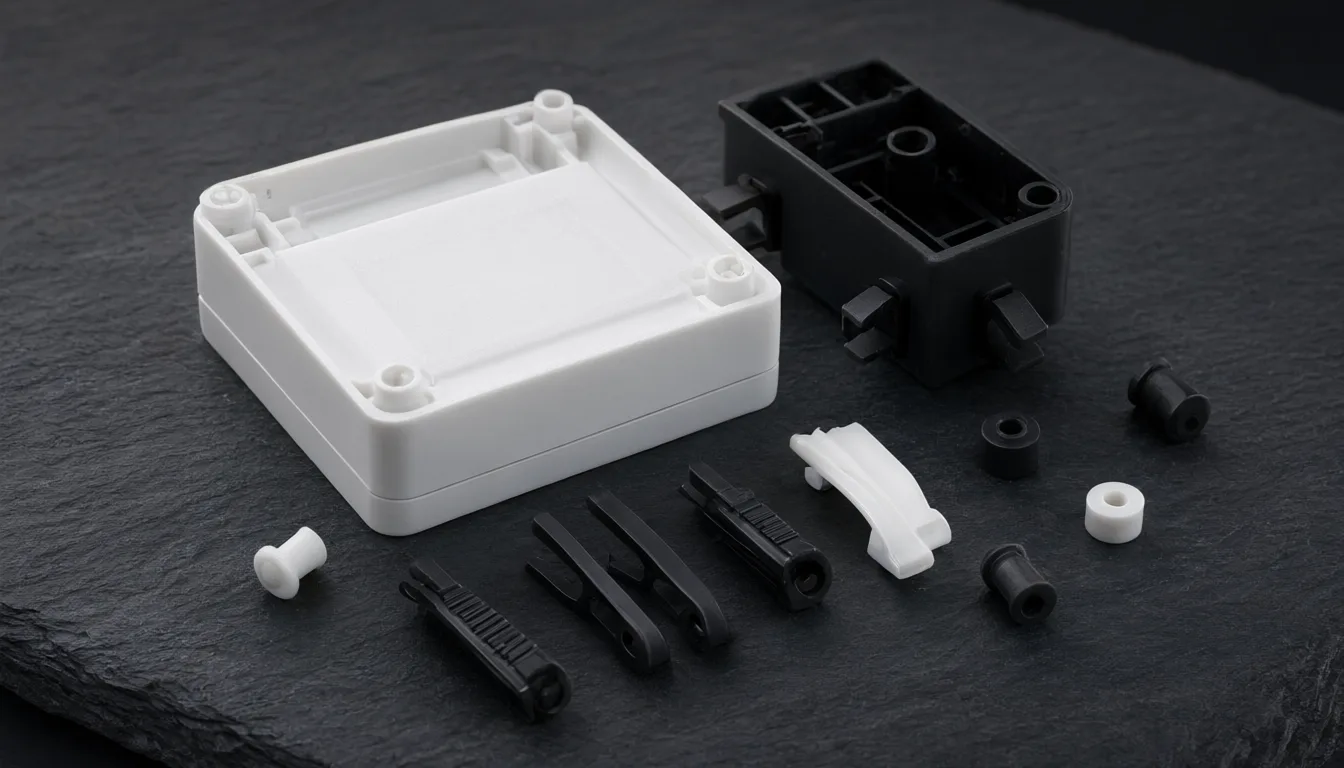
The classic molding failure is not the press — it is the gap between the tool shop and the molder. A drawing leaves a designer, passes a mold maker who negotiates steel alone, arrives at a press house that discovers the gate freezes early, and the fix costs a welded insert and three weeks. MOMAKING collapses that chain: the same engineers who cut the mold set the process on the molding cells, so gate, runner, cooling and cycle are decisions made together, not apologies made later.
Tooling spans aluminum and soft-steel rapid tools for bridge batches (12–25 days) through hardened production tools rated 100k–1M+ shots, single or multi-cavity, family tools where volumes justify them. Molding runs from pilot hundreds to production programs across a press pool sized for housings, clips, connectors, caps and mechanisms — with insert over-molding, assembly, pad-printing and packaging as ordered line items, not surprises.
P20 / 718H / NAK80 / S136, single & multi-cavity, textures and slides. DFM standard, trial shots free.
Details →7075 inserts in 12–25 working days for pilot runs and market tests — then graduate to steel.
Details →| Stage | What happens | You receive |
|---|---|---|
| 1. DFM | Wall/draft/undercut review, gate & parting proposals, resin pick | Marked-up model, free |
| 2. Tool design | 2D layout + 3D tool model for your sign-off | Tool drawings |
| 3. Steel cut | 5-axis + EDM + wire on our floors; photo updates weekly | Progress photos |
| 4. T1 trial | First shots on your resin on our press pool | 5–10 free samples shipped + molded-shot video |
| 5. Correct & approve | Steel edits from your dimensional feedback | Re-trial report |
| 6. Production | Pilot or full runs, inspection per AQL plan, packaging | Parts + QC report |
Typical tool lead 20–45 working days; rapid aluminum tools 12–25. Numbers are MOMAKING's own verified lanes.
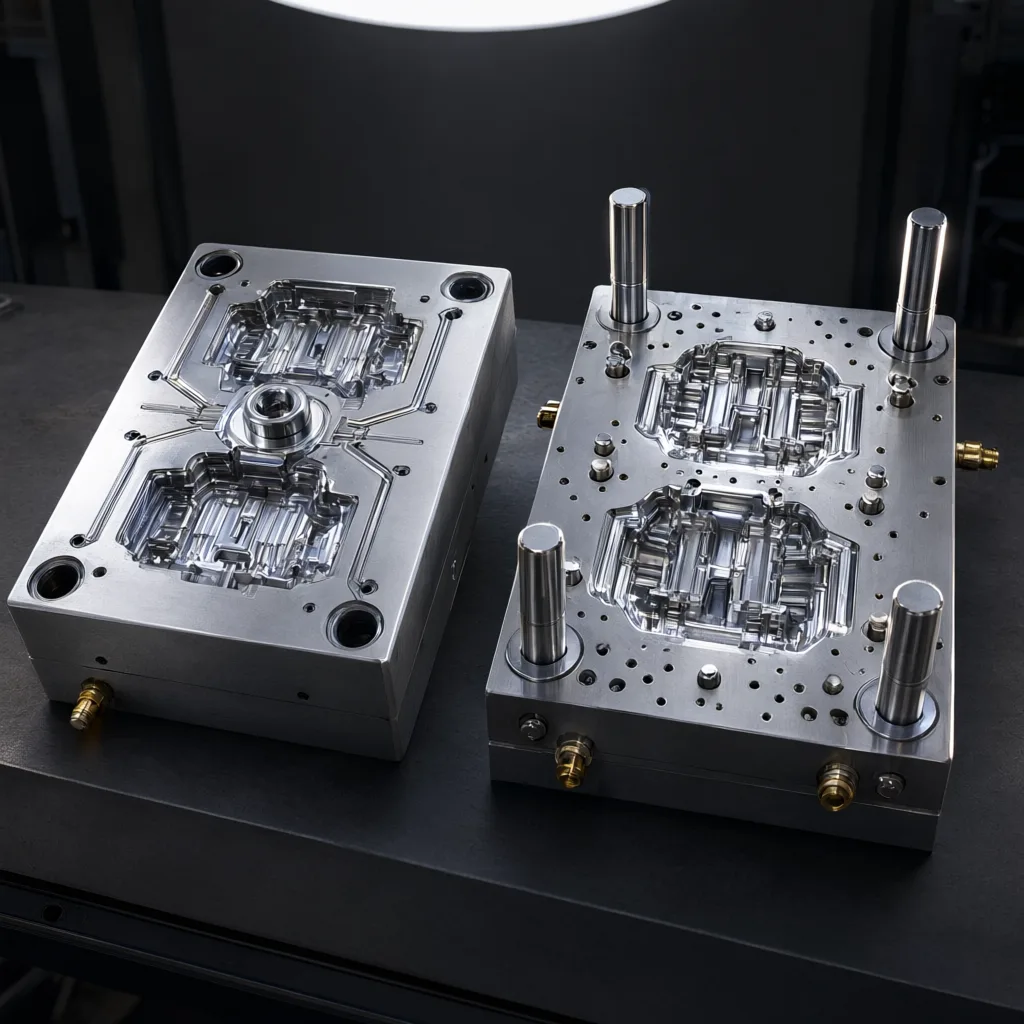
Tool Ownership & Follow-Up
Paid-for tooling belongs to the customer, documented at PO. Stored in our climate-controlled tool store between runs, maintained (rust preventive, guide-pin service, cavity photos) and production-ready when you re-order. If you ever move the tool, it ships — we would rather earn the next program than hold your steel hostage.
Re-orders re-use the validated process parameters kept in the PEKTS-MoE order system: same temps, same cycle, same AQL plan. The part you approved at T1 is the part your fifth reorder matches.
Payment, Shipping & Tool TermsMolding quotes move on resin as much as geometry, because resin dictates the tool's steel, its cooling and its life. ABS is the forgiving default — moderate temps, ordinary shrinkage (~0.5%), plain steel happy. PP shrinks 1.5–2%: cavities get bigger, parting lines re-position, cosmetic sink over ribs becomes a design conversation. PC demands melt temps near 300 °C and hates moisture — dryers belong in the cycle cost and the tool gets hardened gates. Glass-filled grades (any resin, 15–35% GF) scour cavities and preempt the corrosion-resistant hardened inserts and gate wear parts that change the tool price on the spot; they also warp along flow lines, and a warped bracket quotes honestly only when the sim shows the warp — hence the flow analysis recommendation. TPE overmolds add a second tool, a second clamp and a bond-spec conversation. The productive RFQ line is a resin datasheet plus a use sentence; from those, the steel, the simulation verdict and the cycle estimate follow, and the quote stops being a guess dressed as a number.
A related truth about samples: T1 shots out of a hot tool on an unknown process are a draft of the part, not a verdict on it. The first shots often show sink, witness or slight dimensional bias that the process window — or a half-hour of steel polish — corrects. The reason we ship 5–10 free samples with the dimensional layout and the shot video is not generosity theater; it is because that draft round, reviewed together, is where the program's cheap corrections happen. Buyers who treat T1 samples as final acceptance paperwork end up paying for perfection in change orders; buyers who treat them as the scheduled review pay for it in a 90-minute call.
Tools do not die, they are neglected. The maintenance discipline that separates them is boring enough to fit on a card: after every production run, cavities get cleaned of resin bloom and release-agent buildup (the film that accumulates and telegraphs as cosmetic gloss drift); guide pillars and bushings get a grease film — dry steel on steel scores the parting face, and a scored face cannot be unscored except by weld and re-polish; vents get re-cut to depth as they plug with burnt resin (plugged vents = diesel effect, burnt parts, and a 4-hour mystery you don't want); water lines get flushed of scale, because a blocked line warms one cavity and cools the other and the process engineer starts losing cycle time fighting phantom defects. Our tool store runs this card between your runs and photographs the faces on storage checks — when your 18-month re-order arrives, the tool's logbook and its cavity photos ship with the parts, and the first-shot dimensions match the last batch because the geometry never corroded. That logbook is also the proof you want if you ever sell the program or move the tool: condition documented by the party who built it.
Quote anatomy above: every line item ties to the shop's verified lanes (tool room, press pool, inspection room). Ask any supplier to itemize the same seven drivers and compare the honesty of the answers, not the height of the total.
A 2-gram nylon clip program, forecast 400k/year, arrived as a single-cavity tool request because the startup wanted the cheapest first invoice. The quote printed the real curve: single-cavity, $2.2k tool, $0.009/pc at their cycle; 8-cavity, $6.1k tool, $0.0022/pc; 12-cavity, $7.8k tool, $0.0016/pc — and the crossover: at 400k annual volume, the 8-cavity tool pays back its $3.9k difference in eleven days of production, the 12-cavity in fifteen, and the single-cavity option never catches up within the program's life. They ordered the 8-cavity. The 12-cavity had a second-order cost nobody sees in unit prices: its runner balance tightened tolerances into a tool that would demand more commissioning hours at T1 and a stricter press — fine at their volume, money burned at low volumes. Cavitation is a volume decision, and the quote that refuses to print the curve has already picked for you.
Read every molding quote for three sentences that this example hides: what the tool includes (design, trials, freight), what the unit price assumes (resin, cycle, cavitation, hours at the stated rate), and what happens at T1 (the sample-review lane above). Manufacturing pricing lives in those sentences; unit prices are just their shadow.
Send CAD and target volume - DFM notes and tool price within 24 hours, samples off the real tool before you pay the balance.