SLA / Resin Printing
Crystal-clear, white and tough resins at 25–100 μm layers. 24-hour parts with the smoothest surface you can print.
Details →400+ Printer Platform
MOMAKING runs a 400+ machine 3D printing platform in Shenzhen: SLA resin, SLS nylon and metal printing with 24-hour first parts, ±0.05 mm accuracy and 1-piece MOQ — quoted by AI in seconds, shipped worldwide.
24h SLA/SLS · metal in 3-5 days · 400+ printers · same-week batch production
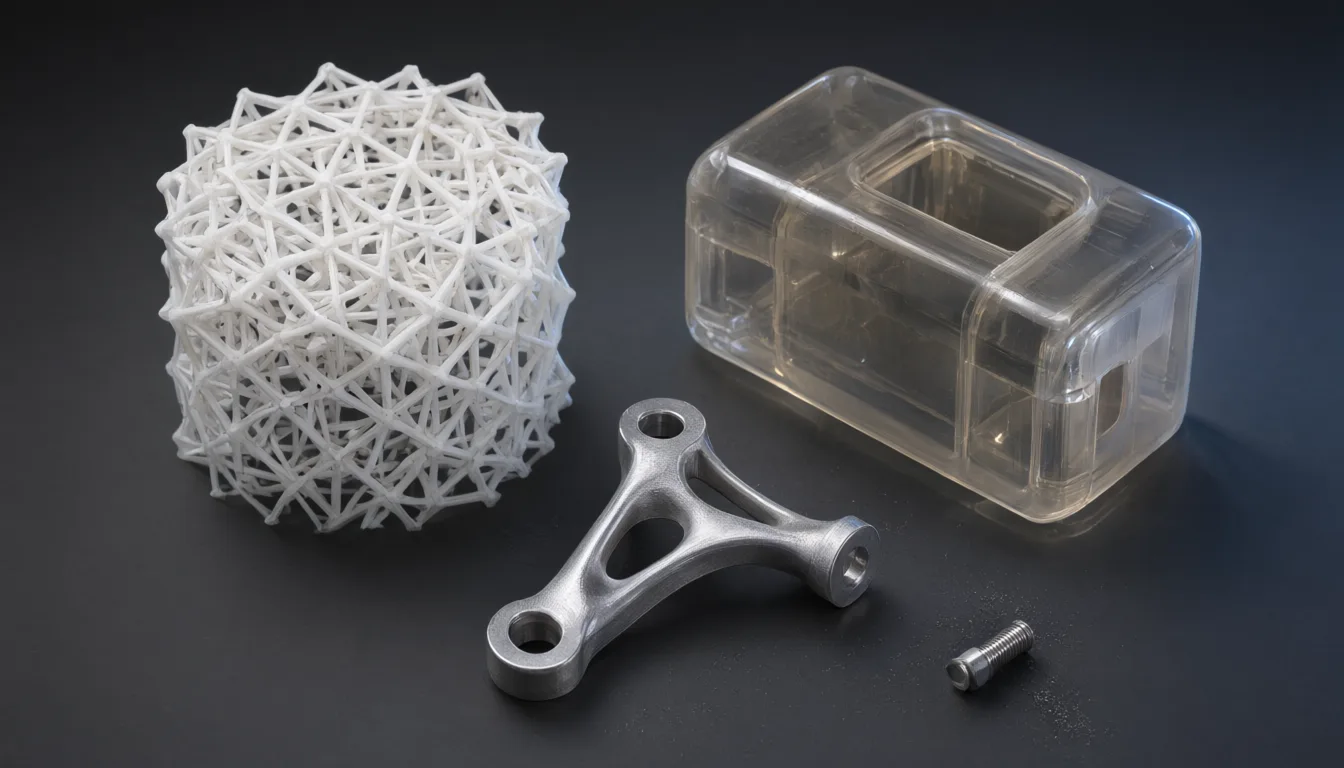
Most buyers arrive with an STL and one question: which technology? The honest answer depends on what the part must survive. Resin (SLA/DLP) gives the smoothest walls and finest detail for visual masters, clear fluidic parts and snap-fit housings. Nylon (SLS) gives isotropic, support-free functional parts — clips, ducts, jigs that survive drops and 80–100 °C. Metal (SLM) gives dense aluminum, stainless and titanium hardware that replaces machined parts where geometry, weight or lead time wins.
Because all three families sit on one platform — and next to a machining shop — hybrid workflows are normal here: a printed body with CNC-finished bearing seats, an SLS assembly with molded clips, a printed bridge part that graduates into injection molding when volume justifies a tool. One engineering file follows the part across every hop.
Crystal-clear, white and tough resins at 25–100 μm layers. 24-hour parts with the smoothest surface you can print.
Details →PA12 functional parts with no supports — living hinges, snap fits, ducts and jigs in grey, white or black.
Details →Ti-6Al-4V, AlSi10Mg and 316L dense metal parts with lattices and organic shapes machines cannot cut.
Details →Resin, nylon and metal grades compared on strength, heat, clarity and cost — with selection rules.
Open guide →Combine printing with 2-day CNC and bridge tooling in one plan with one point of contact.
See program →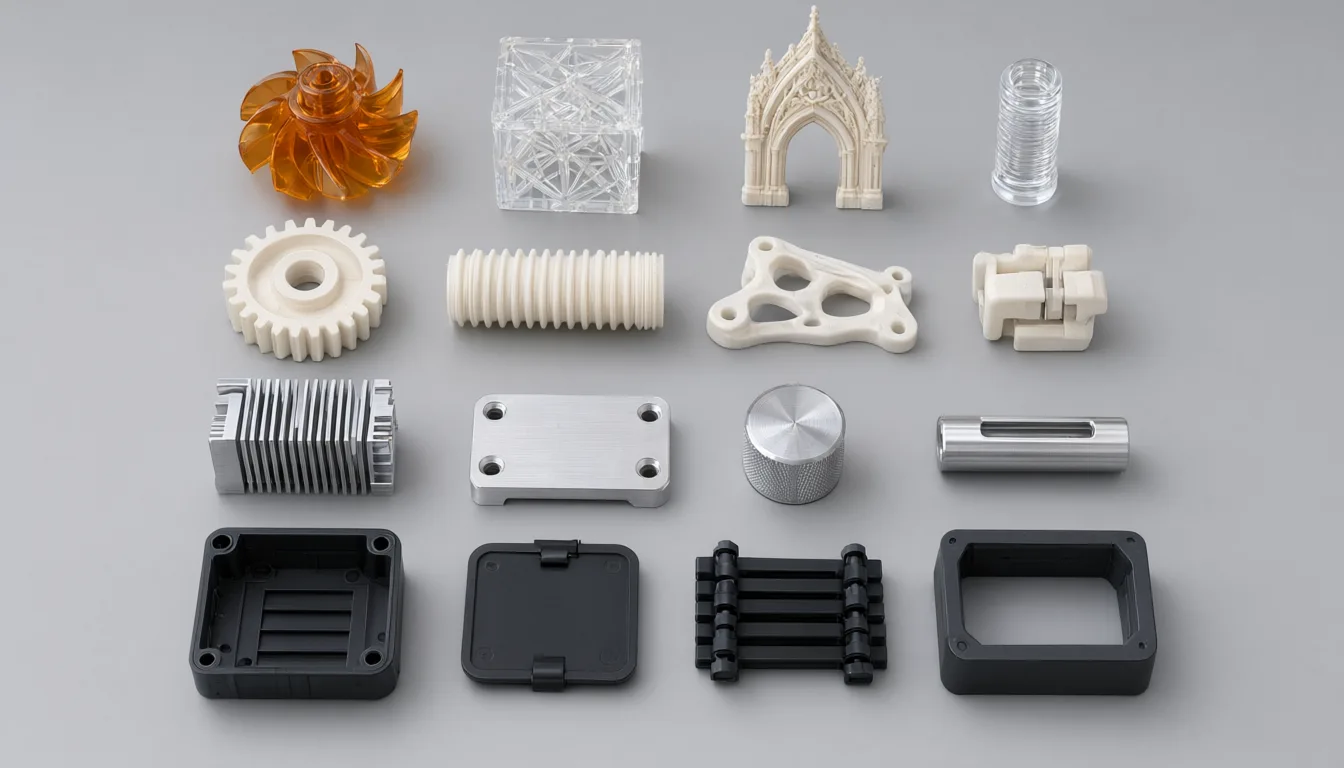
From 1 to 10,000
The 400+ printer pool is not a model shop; it is a production buffer. Groups of machines dedicate to one customer's batch, parts come off with lot traceability, and every shipment carries a dimensional check. When volumes pass the point where per-shot molding economics win, our mold shop converts the same CAD into a tool — the platform's real advantage is that nobody re-onboards you at the handoff.
Material data sheets ship with quotes; certified and biocompatible grades are available on regulated routes. Questions about orientation, wall thickness or nesting? An engineer answers within 24 hours — or on WhatsApp in minutes.
How Ordering WorksDigital manufacturing's quiet superpower is that it has no fixed cost. Injection molding amortizes a four-figure tool across units; printing's cost per part is nearly flat from one to ten thousand, which means the true comparison is never “printing vs molding per piece” but “printing's flat cost line vs molding's declining cost line — where do they cross?” For a 40 gram nylon clip, the cross typically lands between 8,000 and 20,000 units: below that, printing's zero tooling makes it cheaper overall even at three times the unit price; above it, the tool earns its keep and the press takes over. The reason batch printing works commercially at all is that a modern SLS machine drops two hundred clips per build in a day; the machine-hour per part collapses to cents and the flat line becomes very low. Buyers who understand the crossing point stop treating printing as a toy and start treating it as tool-less production for the middle band of the demand curve — the band where most real products actually live.
Two second-order effects matter at that crossing: revision risk and demand risk. A printed part's design change costs a new file upload; a molded part's change costs steel. A product that might sell 3,000 or might sell 30,000 should print while demand is unknown and mold when it is known — printing is not only cheaper for the low case, it is insurance against the case never coming. Our quoting shows the flat line and the crossing point in the same PDF because that chart, not the unit price, is the commercial decision.
Every printed part carries an anisotropy bill: fused layers are strong in-plane, weaker across the bonds. Resin cures layer-wise with z-direction strength roughly half of xy; SLS nylon approaches isotropy in sintered direction pairs but still shows the powder-bed plane; SLM metal parts develop columnar grain along the build direction with ~10–20% elongation differences. The quoting engine reads your load cases when supplied and orients the part so the stress axis avoids the weak plane — the bracket bends across layers, not along them — which often changes platform occupancy and therefore price. This is why two shops can quote the same STL 40% apart: one oriented for strength, one oriented to fill the plate. Ask which way your part is laying; the answer tells you whether you bought engineering or occupancy.
Practical rules that survive any technology: fillet the internal corners (layer bonds hate stress risers), keep wall thickness above 0.8 mm (below that, one missing layer is a hole), put snap fits in the plane that flexes them along bonds not across them, and assume every hole printed circular-shrunk 0.2–0.5% — critical bores get printed undersize and bored or sized on the CNC bench, which is why the print shop and the machine shop sharing a roof is a quality fact, not a marketing one.
Batch printing earns production-grade trust with boring paperwork: each build carries a lot card — machine, powder lot or resin tank, build date, cure profile — and parts ship with a dimensional report drawn from a sample plan sized to your order: first/last plus intermediates per build for small batches, AQL sampling at higher volumes. Critical features get 100% gauging regardless. If your regulator or automotive customer asks where a printed part came from, the lot card answers to the machine number and the powder drum. This is the difference between a print bureau's bag of parts and a manufacturing line's shipment, and it is why aerospace brackets, medical device housings and consumer end-use clips run off the same platform as Friday's prototypes.
Platform figures on this page — 400+ machines, 24 h lead, ±0.05 mm, 100% inspection — are MOMAKING's own verified capability lines, quoted against your geometry rather than averages.
Upload an STL or STEP - AI price in seconds, first resin parts in as little as 24 hours.